

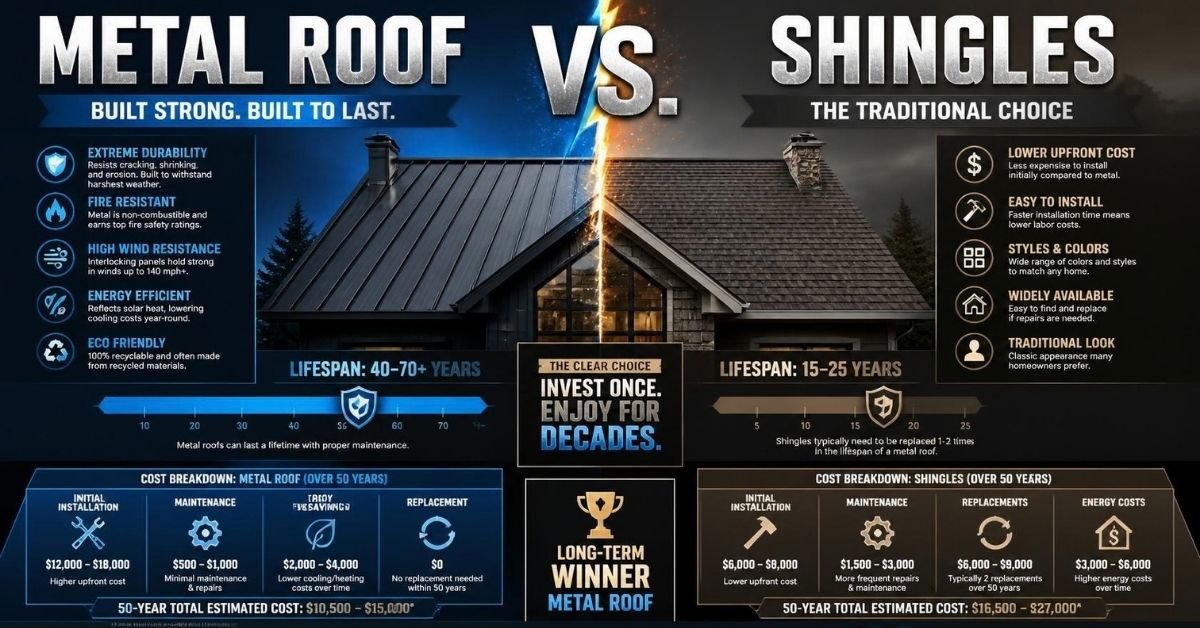
The real question behind a metal roof vs. shingles search is rarely “which material is better.” It is “which roof is better for my house, my climate, my budget, and how long I plan to stay here.” Those four variables pull in different directions, and they explain why you will find confident, contradictory answers online.
Most published metal-versus-shingle comparisons come from roofing companies, including some that install only one of the two materials. One widely circulated comparison is published by a contractor that states it installs metal roofing only and does not install asphalt shingles. Another favours metal but also sells and installs shingle roofs. That does not make the information useless — it means you should read comparative claims as source claims rather than neutral findings.
This article uses the same comparison categories the available sources use — cost, lifespan, and performance — but attributes each figure to the region it came from instead of presenting one national price. It then walks you through material categories, why quotes vary, how to compare on equal terms, and a decision framework plus a contractor question checklist. One safety point up front: roof work is height work. Inspection, repair, and replacement should be handled by qualified roofing professionals, not by homeowners.
Why Metal Roof vs. Shingles Is Not a Simple Answer
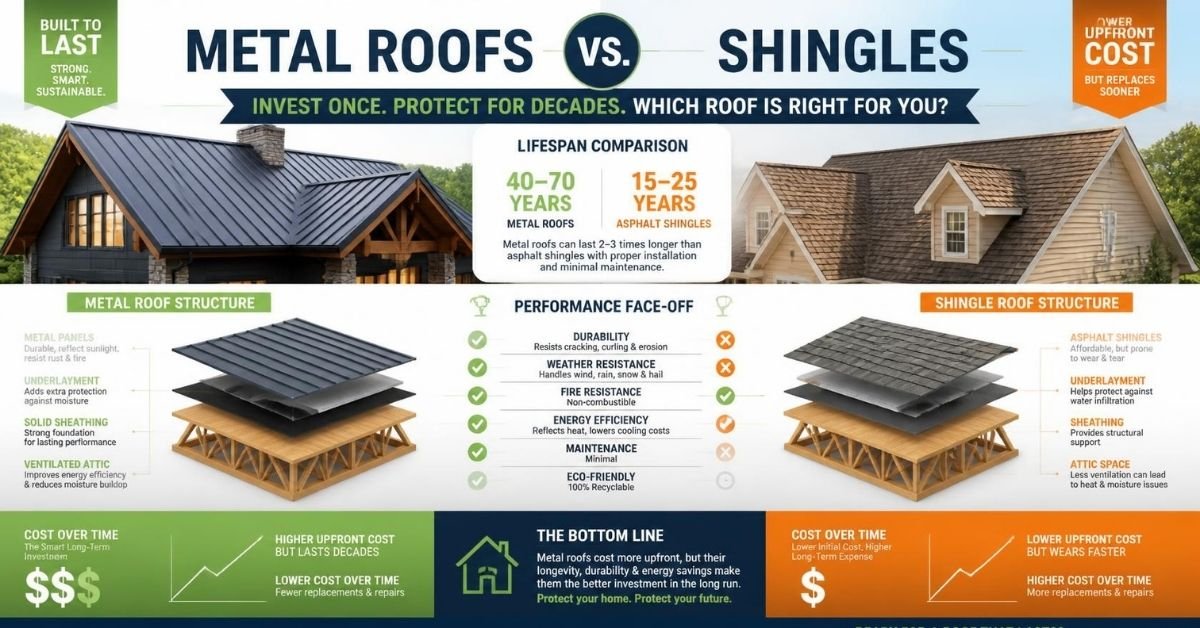
There is no single right answer, and the sources generally say so themselves. The trade-off is straightforward: asphalt shingles cost less up front, while metal costs more up front but is described as lasting longer and behaving differently under weather, heat, and maintenance.
Everything else is a variable you supply.
The reader’s own inputs matter more than any published range:
- Ownership horizon — how long you expect to stay in the home
- Climate exposure — snow and ice, hurricane-season wind, hail, or sustained heat and sun
- Upfront budget — what you can spend now, not what you might save later
- Appearance constraints — including neighbourhood expectations and HOA or architectural review requirements
- Maintenance appetite — how much recurring inspection and upkeep you want to take on
Why Most Published Comparisons Come From Roofing Contractors
Roofing material comparisons are a natural marketing format. They attract exactly the audience a roofing company wants, and they give the company a way to explain its own product line. That origin shapes what you read.
Watch for three signals when you evaluate any comparison:
- What the publisher installs. A comparison written by a metal-only contractor is not automatically wrong, but its conclusions carry a commercial interest in metal.
- Whether cost figures appear at all. Some comparisons quantify costs; others argue for lifetime value without ever stating a price.
- Whether figures come with a location. A price range is only meaningful when you know the region, market, and currency it describes.
None of the four sources used here cites third-party testing, an independent study, or a named standard to support lifespan, energy, or insurance figures. They are contractor statements. Treat them accordingly.
Region, Climate, and Date Change the Numbers
The figures in this article come from sources serving four different parts of the United States: Minnesota, South Carolina, Southeastern Pennsylvania, and Central Texas. All quote prices in U.S. dollars per square foot, but their ranges overlap without matching.
That disagreement is not an error. A roof quote responds to local labour rates, local material supply, roof complexity, and how much weather risk the local market prices in. Costs also move over time, so a figure published in a given year may not describe the market today.
Read every number that follows as source-specific and time-specific. Then get a local quote for your own roof.
Understanding That ‘Shingles’ and ‘Metal’ Are Both Material Categories
Treating “shingles” and “metal” as two single products creates the most common analytical error in this comparison. Both are categories, and the specific product being quoted matters more than the category name.
A category-level claim — a lifespan range, a wind rating, a price per square foot — describes the category, not the panel or bundle that will actually go on your roof. When a contractor quotes you a product, ask for the specification and re-read the comparison at that level.
Asphalt Shingle Grades and How They Differ
The Southeastern Pennsylvania source breaks asphalt shingles into three grades with different durability and price positioning. This matters because “shingles last 15 to 30 years” collapses three products with different performance into one number.
| Grade | How the source describes it | Stated durability positioning |
|---|---|---|
| Three-tab | Most affordable, least durable | Typically 15–20 years |
| Architectural | Better durability and appearance than three-tab; more expensive | Sits between three-tab and luxury |
| Luxury | Imitates slate or wood shakes; significantly more expensive | Lasts longer, but the source still describes it as vulnerable to high winds and hail |
Roughly speaking, comparing a metal roof against a three-tab shingle roof is a different exercise from comparing it against a luxury shingle roof. Both are “shingles” in the category sense.
Metal Profiles and Metal Substrates
Metal roofing spans multiple profiles and materials. The sources name the following.
| Profile or substrate | What the sources describe |
|---|---|
| Standing seam | Vertical panels with concealed fasteners; described as a traditional look in Texas |
| Corrugated | Panel profile named as a residential option |
| Metal shingle | Metal product designed to mimic traditional shingles |
| Metal tile | Tile-profile metal option |
| Substrates | Steel and aluminium named by a Texas source; zinc, copper, and aluminium named by a Pennsylvania source |
Concealed fasteners are worth understanding. On a standing seam system, the fasteners are hidden beneath the panel, which the sources connect to both appearance and weather performance. On exposed-fastener panels, fastener placement and sealing become part of the installation conversation.
The research does not provide metal specifications such as gauge, panel width, coating type, finish, or substrate thickness. Ask the contractor or check manufacturer literature for those details before you commit to a specific product.
Upfront Cost: What Each Material Actually Costs and Why Quotes Vary
Published ranges for a metal roof cost and a shingle roof cost differ by source and region. The honest answer to “how much more does metal cost than shingles” is: more, but how much more depends on where you live and what is being quoted.
What Installed Cost Actually Includes
A roof replacement cost is not the price of materials. A quoted figure typically bundles several things together.
- Materials — the panels, bundles, fasteners, underlayment, and flashing
- Labour — the crew time to remove and install
- Tear-off — removing the existing roof where that is part of the scope
- Deck repair allowance — what happens if the decking underneath needs work
The South Carolina source splits its figures into material cost and installation cost separately, which is useful because it shows where the money goes. For metal, that source lists material at $5–$15 per square foot and installation at $3–$10 per square foot. For shingles, it lists material at $1–$3 and installation at $2–$4 per square foot.
Published Ranges and the Regions They Came From
Here are the researched ranges with their source regions attached. Roofing cost per square foot figures below are in U.S. dollars and come from contractor-published material for the regions named. They are not national averages.
| Source region | Material | Reported installed cost per sq ft |
|---|---|---|
| Minnesota | Asphalt shingles | $3–$5 |
| Minnesota | Metal roofing | $10–$14 |
| South Carolina | Asphalt shingles | $3–$7 |
| South Carolina | Metal roofing | $8–$25 |
The South Carolina source also gives total project figures for a 2,000 sq ft roof: $16,000–$50,000 for metal versus $6,000–$14,000 for shingles. That is the same underlying data expressed at project scale, and it shows how wide the metal range becomes once roof complexity and product choice are folded in.
Notice how differently the two regions frame the same decision. Minnesota’s range puts metal at roughly two to three times the shingle figure. South Carolina’s range starts lower on metal and extends much higher, because it captures a broader spread of metal products and roof configurations. Neither range is wrong. They answer different questions.
Why Two Quotes for the Same House Can Differ
Two contractors can walk the same roof and return numbers that are thousands of dollars apart without either of them being dishonest. Several factors drive the gap:
- Roof complexity — hips, valleys, dormers, and penetrations all consume labour and material
- Roof pitch — steeper roofs take longer and require more fall protection
- Accessibility — driveway access, landscaping, and how far materials must be carried
- Tear-off versus overlay — removing the old roof costs money; leaving it in place does not
- Deck condition — what a contractor assumes about the sheathing underneath
- Flashing and ventilation scope — whether these are replaced or reused
- Local market conditions — labour availability and material supply in your area
Because of this, general ranges are useful for budgeting and for spotting an outlier, but they cannot price your roof. Request a local estimate for your specific home, and compare quotes on the scope each one describes rather than on the headline number.
Lifespan and Replacement Cycles: How Long Each Roof Lasts
Reported metal roof lifespan and asphalt shingle lifespan ranges vary by source, climate, and product grade. They are vendor-stated ranges, not independently tested performance data.
| Source region | Reported asphalt shingle lifespan | Reported metal lifespan |
|---|---|---|
| Southeastern Pennsylvania | 20–30 years (standard asphalt shingles) | 40–80 years |
| Minnesota | 15–30 years | 40–70 years |
| South Carolina | 15–30 years | 40–70 years |
| Central Texas | 15–25 years | 40–70+ years |
The Pennsylvania source frames its comparison as metal delivering two to four times the service life of other roofing materials. The South Carolina source describes metal as lasting two to three times as long as shingles. Different multipliers, similar direction.
Shingle Lifespan and the Conditions That Shorten It
Shingle lifespans cluster around 15 to 30 years across the sources, with the Central Texas source narrowing that to 15 to 25 years in Texas heat. The Pennsylvania source puts three-tab shingles at 15 to 20 years specifically.
Heat drives much of the aging. The Texas source describes asphalt shingles absorbing and trapping heat, with constant thermal expansion and contraction leading to granule loss, cracking, and premature aging. The Pennsylvania source lists the same failure modes — curling, cracking, granule loss, algae growth, water damage, and storm damage — as ongoing concerns.
Ventilation appears in the research as a lifespan factor rather than a comfort detail. The Pennsylvania source states that inadequate ventilation, along with misaligned shingles and improper sealing, can shorten roof life and create repair costs.
Metal Lifespan and the Conditions That Shorten It
Metal lifespans in the sources run from 40 to 80 years depending on the source. The Central Texas source states 40–70+ years, the Minnesota and South Carolina sources both state 40–70 years, and the Pennsylvania source states 40–80 years.
Finish and coating durability matter here. The Minnesota source notes that metal finishes are described as maintaining their appearance longer than shingle surfaces, which matters because a panel that still performs structurally but looks worn creates a different decision than a failed roof.
The same installation and ventilation factors that affect shingles affect metal systems. The Texas source states that improper metal installation can cause leaks or performance problems, and describes metal as requiring skilled, specialised installation. The research does not contain guidance on how to assess a specific metal product’s coating warranty or finish life, so ask the contractor for that information.
How Many Roofs Will the Home Need?
The Central Texas source offers an illustrative framing: a shingle roof may need replacing two or even three times over the service life of one properly installed metal roof. It notes that each replacement brings fresh labour, materials, tear-off costs, and possible storm damage repairs.
That is a useful way to think about the decision, but it is a scenario, not a prediction. Lifespan depends on product grade, climate, installation quality, ventilation, and maintenance — not on the material name alone. A well-installed architectural shingle roof in a mild climate and a poorly installed metal roof in a hailstorm belt will not behave the way the category averages suggest.
Cost per Year of Service Life: Comparing Materials on Equal Terms
Cost per year of service life is a way of comparing materials with different lifespans by dividing total installed cost by expected years of service. It puts an $18,000 metal roof and a $9,000 shingle roof into the same units.
The South Carolina source runs this calculation and reports roughly $230–$1,250 per year for metal over a 40–70 year life, and roughly $200–$933 per year for shingles over a 15–30 year life. Its own conclusion is that the two come out roughly even on that metric.
The Arithmetic Behind the Comparison
The method is simple:
- Take the total installed cost from your quote.
- Divide by the number of years you expect the roof to serve.
- Compare the resulting annual figures.
On the published ranges, the South Carolina source’s figures show substantial overlap. Metal’s high end ($1,250 per year) is higher than shingles’ high end ($933), but metal’s low end ($230) sits close to shingles’ low end ($200). The ranges overlap across most of their span.
Two inputs drive the result more than anything else: the installed cost and the assumed lifespan. Because those inputs come from a price range rather than a fixed quote, the output inherits the uncertainty of both.
When the Comparison Comes Out Roughly Even
The South Carolina source concludes the materials come out roughly even on cost per year. If that holds for your numbers, the decision shifts away from pure economics and toward the factors the arithmetic cannot capture — climate performance, appearance, maintenance preferences, and how long you plan to stay.
The arithmetic is also sensitive to whether the metal roof is installed over the existing shingles or requires a full tear-off. Overlay can reduce the installed cost side of the equation, but it gives up the deck inspection that removal allows. That trade-off is covered later in this article.
Break-Even Thinking for Your Own Numbers
Rather than relying on published ranges, run the calculation on your own quotes. Here is a framework.
- Get a written quote for a metal roof and a written quote for a shingle roof, both describing the same scope where possible.
- Subtract the shingle figure from the metal figure. That difference is your upfront premium.
- Divide the premium by the annual cost of replacing shingles again. That tells you roughly how many years of avoided replacement the premium represents.
- Compare that number against how long you expect to own the home.
If the answer comes out longer than your ownership horizon, the arithmetic favours the lower upfront cost for you. If it comes out shorter, the metal premium has more room to work. Either way, the calculation makes your assumptions explicit instead of leaving them as a feeling.
Note what this framework cannot tell you. It does not account for energy savings, insurance discounts, or storm damage repairs, because the research does not provide reliable figures for those at a household level. It also assumes your lifespan estimates are sound, which is the weakest link in the whole calculation.
Weather Performance: Wind, Hail, Rain, Snow, and Ice
Weather performance claims in the research are attached to specific products and systems rather than to the words “metal” and “shingles.” That distinction matters more here than anywhere else in the comparison.
Wind Ratings and What They Depend On
Two sources cite a roof wind rating of up to 140 mph for standing seam metal systems. One is the Minnesota source and one is the South Carolina source.
Read that figure carefully. It is attached to standing seam systems, not to metal roofing in the abstract, and actual performance depends on the specific product, how it is fastened, and the quality of the installation. The research does not provide a formal rating framework or testing basis for the figure, and no equivalent rating appears for asphalt shingles.
If wind matters in your area, ask the contractor what rating the exact quoted product carries and how the installation preserves it.
Hail and Impact Performance
The Central Texas source states that many metal systems are described as impact-rated and better able to handle hail than traditional shingles, and it describes properly installed metal systems as able to withstand high wind speeds common in Texas storms. The Pennsylvania source states metal withstands hailstorms and high winds more easily than asphalt shingles.
Asphalt shingles appear on the other side of these claims. The Texas source lists vulnerability to high winds and hail damage among shingle drawbacks. The Pennsylvania source notes that even luxury shingles remain vulnerable to high winds and hail despite their higher cost.
The research does not include hail impact classifications or a formal rating structure for either material. Treat hail and impact performance as product-specific, and ask for the manufacturer’s documentation on the product being quoted rather than relying on a category claim.
Snow Shedding and Ice Dam Considerations
Snow behaviour separates the two materials most clearly in cold climates. The Minnesota source states that metal roofing sheds snow efficiently and that this can reduce ice dam risk during winter.
That is a genuine functional difference rather than a marketing claim. Snow that slides off a smooth metal surface does not sit and melt and refreeze the way it can on a granular shingle surface. However, the same source notes that ice dams remain a winter concern, and ice dam prevention involves the whole roof assembly — insulation, ventilation, and drainage — not just the surface material.
Snow shedding also has a practical consequence the research does not quantify: snow releases suddenly rather than gradually, and where it lands matters. Ask your contractor about snow guards and about doorways and walkways below the roof edge.
Aging Under Heat, Sun, and Thermal Cycling
Hot climates stress roofs in a different way. The Central Texas source identifies heat as the biggest factor affecting asphalt shingles there, describing heat absorption followed by expansion and contraction that produces granule loss, cracking, and premature aging.
Metal behaves differently under sun. The Texas source describes metal reflecting solar radiant heat rather than absorbing it, and helping reduce attic temperatures. The Minnesota source describes metal resisting UV deterioration, and the Pennsylvania source states metal reflects sunlight and UV rays.
Regional climate should shape your choice. Northern snow and ice conditions, hurricane-season wind and heat, hail-prone regions, and hot-climate sun exposure each stress a roof differently. Consult a roofing contractor familiar with local conditions before deciding, and weigh their experience with your specific exposure rather than a general recommendation.
Heat, Sun, and Energy Behaviour
The energy question gets more marketing attention than almost any other part of this comparison, so it deserves careful handling.
How Reflective Metal Roofs Are Described
Reflective metal roofing works on a simple principle: a light-coloured or specially finished surface reflects solar radiation instead of absorbing it. The sources describe the mechanism and connect it to attic temperature.
The Minnesota source states that metal roofs reflect solar heat and may reduce cooling costs by 10% to 25%. The South Carolina source reports the same 10% to 25% range for cooling costs. The Pennsylvania source describes metal as reflecting sunlight and UV rays and describes solar reflectivity as an energy efficiency mechanism.
Why Shingles Absorb Heat and What That Does Over Time
Asphalt shingles absorb heat. The Pennsylvania source ties this to reduced energy efficiency and higher utility bills, and the Texas source connects heat absorption to the aging process described earlier — expansion and contraction leading to granule loss, cracking, and premature aging.
So heat affects the two materials in two different ways. For shingles, heat is primarily a durability issue. For metal, reflectivity is primarily a comfort and cooling-load issue. Those are separate conversations that often get blended together in comparisons.
Setting Realistic Expectations for Bill Savings
The 10% to 25% cooling cost range appears in two sources, but neither cites utility data, an independent study, or a testing standard. Treat it as a general claim rather than a guaranteed figure.
Cooling savings also depend heavily on things that have nothing to do with the roof surface:
- Attic insulation levels — the biggest single factor in most homes
- Ventilation — intake and exhaust balance affects attic temperature independently of roofing material
- Attic condition — air sealing and duct leakage
- Local climate and cooling load — how much air conditioning you actually run
A reflective roof and an under-insulated attic are not a substitute for each other. Before buying on energy grounds, verify expectations with your utility or an independent source rather than relying on vendor claims, and ask whether your attic insulation and ventilation are due for attention regardless of which roof you choose.
Maintenance: What Each Roof Asks of You Over Its Life
Maintenance burden is one of the clearest practical differences between the two materials, though the research describes maintenance types rather than frequencies or costs.
The Shingle Inspection Routine
Asphalt shingles require recurring attention. The Minnesota source describes regular inspections for damage, especially after storms, and identifies moss growth as a susceptibility. The Pennsylvania source lists granule loss, algae growth, water damage, and storm damage as ongoing concerns and describes post-storm inspection as a recurring practical need.
Granule loss is the mechanism behind much of this. As granules shed from the shingle surface, the asphalt underneath is exposed to UV radiation and ages faster. Algae growth shows up as dark streaking and is a cosmetic issue in most cases, though the Pennsylvania source lists it among shingle drawbacks.
Ventilation sits underneath all of this. The Pennsylvania source links inadequate ventilation to shortened shingle roof life, which makes ventilation a maintenance-adjacent topic worth confirming with your contractor.
Metal Cleaning and the Organic Growth Question
Metal maintenance is described as minimal. The Minnesota source states that metal requires minimal maintenance beyond occasional cleaning and resists organic growth and UV deterioration. The Pennsylvania source describes metal as requiring almost no maintenance. The Central Texas source states that metal has lower long-term maintenance costs, though it does not detail what that maintenance involves.
Organic growth is the one that surprises homeowners. The Minnesota source describes metal as resisting organic growth, but that does not mean a metal roof never develops anything on its surface. Debris accumulation in valleys, around penetrations, and in gutters can support growth regardless of the roofing material, which is part of why “occasional cleaning” appears in the description.
Repair Ease and Repair Skill
The two materials differ in how repairs work, not just how often they are needed.
Asphalt shingles are comparatively easy to repair in small sections — the Texas source lists easy repair in small sections as a shingle advantage, and the South Carolina source describes individual shingles as replaceable quickly and shingle repairs as easier and cheaper. For a homeowner facing a single damaged area after a storm, that is a real practical benefit.
Metal repairs are described differently. The South Carolina source states that metal roof repairs are less common but require specialised skills when needed. That matters for long-term serviceability: a roof that rarely needs repair but needs a specialist when it does creates a different ownership experience than one that needs attention more often but responds to routine work.
The research does not cover denting, walkability, or access concerns on metal roofs. Ask your contractor about those directly rather than assuming either way.
Why Roof Inspection and Repair Belong to Qualified Professionals
Roof inspection, cleaning, and repair all involve working at height, and the surfaces involved can be slick, hot, steep, or fragile. This is not homeowner work.
- After a hailstorm or high-wind event, have a qualified roofing professional inspect the roof rather than assessing it from the ground.
- For any repair, use a roofing professional. Metal repairs in particular are described as requiring specialised skill.
- For structural questions — whether your roof structure can carry a metal system, whether your roof pitch suits a particular product, whether your decking is suitable — involve a qualified contractor or a structural engineer. The research does not address these questions, and they are not answerable from a comparison article.
Insurance, Fire Performance, and Other Practical Considerations
Beyond cost and lifespan, several secondary factors influence the decision. Each one is a claim to verify rather than accept.
Premium Discounts and How to Verify Them
The Minnesota source states that insurance companies offer discounts for homes with metal roofs because of their durability. The South Carolina source goes further, citing potential metal roof insurance discount figures of 5% to 25% in premiums, with shingles typically receiving standard rates.
Those numbers come from a single contractor in a single state. Discount eligibility and size vary by insurer, by location, by the specific product installed, and by what documentation the insurer requires. Before you factor a discount into your budget, call your insurer and ask three questions directly:
- Do you offer a premium discount for the specific roofing product being quoted?
- What documentation do you require to confirm it?
- Does the discount apply from the date of installation, or at renewal?
If the answer is unclear, price the roof without the discount and treat any saving as a bonus.
Fire Ratings and Lightning Questions
The Pennsylvania source states that a typical metal roof offers the highest level of fire protection, described as a Class A fire rating. That is a classification referenced in the research for metal roofing, not a universal statement about every metal product. If fire rating matters for your property — and it often does for insurance purposes — ask for the specific product’s listing documentation.
The lightning question comes up frequently. The South Carolina source states that metal roofs do not attract lightning any more than other roofing materials and that the material is non-combustible if struck. This is a widely repeated assertion, and the research presents it as a claim rather than citing a testing standard or authoritative reference. Verify it with a qualified source before relying on it for a decision.
Noise on Metal Roofs and the Role of Decking
“Is a metal roof noisy?” has a specific answer in the research, with a caveat. The South Carolina source states that modern metal roofs installed over solid decking and underlayment dampen rain noise to levels comparable with shingles.
The research provides no quantified noise data — no decibel comparisons, no measurements, no testing. The comparison is qualitative. What the source does make clear is that the roof assembly matters: solid decking and underlayment are doing the acoustic work, not the metal panel. A metal roof installed over an assembly without those layers would presumably behave differently, which makes the specification of your roof assembly a question worth asking.
How to Verify Energy, Insurance, and Performance Claims Independently
Because the available comparison content is contractor-published, verification is part of the buying process. Here is where to take each claim:
| Claim type | Where to verify |
|---|---|
| Energy and cooling savings | Your utility, or an independent energy assessment |
| Insurance discounts and coverage | Your own insurer, before you buy |
| Wind ratings and impact performance | Manufacturer product literature for the exact quoted product |
| Fire classification | Product listing documentation |
| Permits, inspections, and overlay limits | Your local building department |
| Appearance and community requirements | Your HOA or architectural review body |
| Lightning and other safety claims | An authoritative technical reference, not a vendor page |
On sustainability, the research is thin. The Central Texas source describes metal roofing as environmentally friendly and recyclable, which supports a statement about end-of-life recyclability and not much more. The research does not cover recycled content, embodied carbon, or what happens to asphalt shingles at end of life.
One claim you may encounter elsewhere is not supported by this research at all: that a metal roof increases resale value. Treat that as an unsupported assertion unless you find evidence specific to your market.
Appearance: Profiles, Colours, and the Shingle-Look Metal Option
Appearance is a real constraint, not a cosmetic afterthought. It can end the comparison entirely in some neighbourhoods.
Standing Seam, Corrugated, Metal Shingle, and Metal Tile
Metal roofing is not a single look. The sources describe several distinct profiles, and they read very differently on a house.
- Standing seam — vertical panels with concealed fasteners, described by the Texas source as a traditional look in that region
- Corrugated — a panel profile named as suitable for residential use
- Metal shingle — designed to mimic traditional shingles
- Metal tile — a tile-style metal profile
Substrates add further variation. Steel and aluminium appear in the Texas source; zinc, copper, and aluminium appear in the Pennsylvania source. Each substrate has its own appearance, weight, and cost characteristics.
When Neighbourhood or HOA Expectations Matter
Metal products engineered to imitate asphalt shingles, slate, or wood shakes exist, and the Pennsylvania source states that modern metal roofing can mimic the look and feel of asphalt shingles so closely that the two are nearly indistinguishable. That undermines the assumption that choosing metal necessarily changes how a house looks.
It does not, however, override community rules. The South Carolina source notes that some neighbourhoods and HOAs prefer the traditional look of shingle roofs, and that this can be a non-cost factor in material choice. Architectural review requirements are community-specific, and no general rule applies.
Check before you order, not after. Two reasons: profile and colour choices are often locked in early in the ordering process, and an approval problem discovered late is expensive to correct. The Minnesota source also notes that metal finishes are described as maintaining their appearance longer than shingle surfaces, which is worth weighing if curb appeal over a long horizon matters to you.
Can You Install Metal Over Existing Shingles?
Overlay — installing a metal roof over an existing single layer of shingles — may be possible and can reduce tear-off costs. The available sources do not treat it as the default recommendation, and local rules govern whether it is allowed at all.
What Overlay Can Save and What It Costs You
The South Carolina source states that installing metal over an existing single layer of shingles is possible and can save on tear-off costs. The savings come primarily from two places: the labour to remove the old roofing, and the disposal fees to get rid of it.
What overlay gives up is access. Once new roofing covers the old, the decking beneath is out of reach. Any soft spots, rot, or previous water damage stay hidden until they cause a problem that shows up from below.
Why Decking Inspection Often Decides the Question
The same source states that the contractor generally recommends removing old shingles first so the decking can be inspected and repaired. That is the practical argument against overlay, and it is not primarily a cost argument.
Deck condition shows up in quotes as a repair allowance. A contractor who assumes the deck is sound and finds rot after tear-off will need to address it as a change to the scope. A contractor who removes the old roof first finds out before the new roof goes on.
Overlay is also governed by rules you cannot see from a comparison article. Permit requirements, inspection rules, overlay layer limits, and manufacturer warranty conditions all vary by jurisdiction and by product. Some manufacturer warranties may not cover installations over existing roofing. Confirm all four points locally — with your building department and with the manufacturer’s literature for the quoted product — before treating overlay as an option.
Installation Quality: The Factor That Can Outweigh the Material
Installation quality may matter as much as material choice. Two houses with identical materials can end up with very different roofs depending on who installed them and how.
How Shingle Installation Affects Longevity
The Pennsylvania source identifies three installation factors that shorten shingle roof life: misaligned shingles, improper sealing, and inadequate ventilation. All three are workmanship and assembly issues rather than product issues.
The implication is straightforward. A premium architectural shingle installed badly may underperform a mid-grade shingle installed correctly. When you compare quotes, the difference between the low bid and the middle bid is often in the details that determine how long the roof actually lasts.
Why Metal Is Described as a Specialty Trade
The Central Texas source states that metal roofing is not general roofing work but a skilled specialty, and that improper installation can lead to leaks or performance problems. The Pennsylvania source similarly advises using a qualified metal roofing contractor.
That matters for hiring. If you choose metal, look for a contractor who installs metal systems regularly rather than occasionally. Ask how many metal roofs the crew completes in a typical year and whether they have completed systems in the specific profile you are considering.
It also matters for the wind and impact claims discussed earlier. A rated product installed without the fastening pattern and detailing the rating assumes may not perform to that rating. This is why wind ratings, impact performance, and lifespan should all be read as product-plus-installation claims rather than material claims.
When comparing quotes on scope rather than headline price, check that these are addressed:
- Flashing details at valleys, walls, chimneys, and penetrations
- Ventilation — intake and exhaust, not just a ridge vent
- Underlayment type and coverage
- Fastener specification and pattern
- Deck repair allowance
How to Choose: A Decision Framework Based on Your Situation
The research points to a handful of inputs that do most of the work in this decision. Ownership horizon is the clearest of them.
| Your situation | What the research points toward | Why |
|---|---|---|
| Staying long term | Metal, on cost per year of service | Long-term ownership is where the longer lifespan and lower replacement frequency have time to matter |
| Selling within a short window | A quality architectural shingle roof | Lower upfront cost, and a buyer inherits remaining service life rather than a large premium |
| Climate is the deciding factor | Depends on the exposure — see the climate section below | Snow and ice, hail, hurricane wind, and sustained heat stress roofs differently |
| Upfront budget is the constraint | Shingles, with metal revisited later | The metal premium is real, and financing it badly is worse than choosing a good shingle roof |
| Appearance or HOA constraints | Whatever satisfies the requirement | A roof you cannot install is not a choice |
| Low maintenance appetite | Metal, on maintenance description | Metal is described as requiring minimal maintenance versus recurring shingle inspections |
If You Plan to Stay Long Term
The South Carolina source states that homeowners planning to stay 15 or more years may find metal costs less per year of service than shingles. The cost-per-year arithmetic is where that argument lives, and it holds when you expect to capture the full service life yourself.
Weigh the upfront price alongside overall value rather than price alone, but be honest about the horizon. Fifteen years is a long commitment, and the argument weakens considerably if you might move before then.
If You Plan to Sell Soon
The same source frames selling within 5 to 10 years as a situation where a quality architectural shingle roof offers strong curb appeal and good return without the higher upfront cost. The logic is that you pay the metal premium now and the buyer inherits the benefit later.
If you expect to sell soon, ask yourself what roof service life a buyer would actually be purchasing. A new architectural shingle roof with 25 years ahead of it is a straightforward selling point. A metal roof with 70 years ahead of it may be worth more, but how much more it changes the sale price is not something this research can tell you — no resale value evidence appears in any of the sources.
If Your Climate Is the Deciding Factor
Climate stress varies, and so does what the sources say about it.
- Northern snow and ice. The Minnesota source describes metal as shedding snow efficiently and reducing ice dam risk. Snow guards and snow release below the roof edge are practical questions for the contractor.
- Hurricane-season wind and heat. The South Carolina source sits in this context and states that metal handles intense summer heat, hurricane-season winds, and heavy rain well.
- Hail-prone regions. The Texas source describes many metal systems as impact-rated and better able to handle hail than traditional shingles. Ask for the rating on the specific product.
- Hot-climate sun exposure. The Texas source identifies heat as the dominant aging factor for shingles there and describes metal as reflecting solar radiant heat.
Consult a roofing contractor who works in your climate regularly. Recommendations from a contractor who has never seen a hail claim are not much use if hail is your main concern.
If Upfront Budget Is the Constraint
If the metal premium does not fit your budget, a shingle roof is not a compromise — it is the practical choice. The South Carolina source notes that shingles remain the most popular roofing material in its region, and the Pennsylvania source describes asphalt shingles as the most common residential roofing nationally.
The variable you control is grade. Three-tab shingles sit at the bottom of the durability and price range, typically 15 to 20 years per the Pennsylvania source. Architectural shingles sit above them on both dimensions. A well-installed architectural shingle roof is a different product from a three-tab roof, and the difference is worth understanding before you accept the lowest bid.
Also consider sequencing. Replacing a shingle roof now does not lock you out of metal later. It does mean paying for a tear-off at that point, which is worth knowing when you run the break-even calculation.
What to Ask a Roofing Contractor Before You Commit
This checklist converts the comparison into specific questions. Take it to each contractor you speak with, and compare the answers rather than the bottom line.
Questions About Scope, Decking, and Tear-Off
- What does this price assume about the condition of the decking, and what happens if you find damage?
- Are you proposing tear-off or overlay — and why?
- What is included for flashing at valleys, walls, chimneys, and penetrations?
- What ventilation work is included?
- What is the underlayment specification?
- Is roof repair or replacement of any decking charged separately, and at what rate?
Questions About Warranties and Verification of Claims
- How long does your workmanship warranty run?
- Does it transfer if I sell the house?
- Does the proposed installation preserve the manufacturer’s warranty on the product?
- What wind rating does the exact product you are quoting carry, and how does the installation maintain it?
- If you are quoting metal, how much of your work is metal systems?
- Can you provide the manufacturer’s literature for the quoted product?
- What maintenance does this roof need, and what does that involve?
Questions About Local Code, Permits, and Approval Requirements
- What permits does this job require, and who pulls them?
- What inspections will happen, and at what stages?
- Is overlay permitted on my roof under local rules?
- Does overlay affect manufacturer warranty coverage?
- Does my HOA or architectural review body need to approve the material, profile, or colour?
- Are there snow load, wind, or other structural considerations for my roof that need an engineer’s input?
Confirm all of the above locally. Permit rules, inspection requirements, overlay limits, and HOA approvals are jurisdiction- and community-specific, and the available research does not cite any code or standard. Your building department and your HOA are the authoritative sources.
Two practical notes. First, decide appearance early — profile and colour choices are often locked in before ordering, and changing them later is difficult. Second, obtain local estimates and compare them on like-for-like scope. A quote that omits flashing or ventilation is not cheaper; it is incomplete.
And throughout: all roof work is height work. Inspection, repair, and replacement belong to qualified roofing professionals.
Frequently Asked Questions About Metal Roofs and Shingles
Which lasts longer, a metal roof or asphalt shingles?
Reported ranges put asphalt shingles at roughly 15 to 30 years and metal at roughly 40 to 70 years, with one source citing 40 to 80 years. These are vendor-stated ranges, not independently tested figures. Lifespan depends on product quality, climate, installation quality, ventilation, and maintenance.
How much more does a metal roof cost than shingles?
Published ranges differ by region. A Minnesota source reports $3–$5 per square foot for shingles and $10–$14 for metal. A South Carolina source reports $3–$7 per square foot installed for shingles and $8–$25 for metal, with a 2,000 sq ft project example of $6,000–$14,000 for shingles versus $16,000–$50,000 for metal. Prices vary by region, currency, year, roof complexity, and market conditions. Get a local quote.
Do sources agree on roofing costs, and why do the numbers vary so much?
They do not agree. The available comparisons are largely contractor-written, at least one is published by a metal-only installer, and each published range comes from a specific region. Scope differences, roof complexity, and local market conditions all move the figure.
Is metal roofing worth the extra upfront cost?
The research does not settle this. The cost-per-year-of-service calculation in the South Carolina source comes out roughly even between the two materials. Ownership horizon is the clearest decision input: long-term ownership is framed as favouring metal on cost per year, while selling within a short window is framed as favouring a quality architectural shingle roof on upfront cost.
Will a metal roof lower my energy bills?
The sources describe reflective metal roofing reducing cooling costs by 10% to 25%, but they cite no utility data or independent testing. Treat it as a general claim. Verify expectations with your utility or an independent source, and remember that insulation, ventilation, and attic condition affect cooling load as much as the roof surface.
Can a metal roof earn me an insurance discount?
The research cites potential premium discounts for metal and standard rates for shingles. Discount eligibility, size, and documentation requirements vary by insurer and location. Confirm with your own insurer before buying.
Is a metal roof louder than shingles in the rain?
One source states that metal installed over solid decking and underlayment produces rain noise comparable to shingles. The research provides no quantified noise data — no measurements or decibel comparisons — so the comparison is qualitative. The roof assembly is doing the acoustic work, which makes assembly specification worth asking about.
Does a metal roof attract lightning?
The research states that metal does not attract lightning more than other materials and is non-combustible if struck. This is a widely repeated assertion and the sources cite no testing standard or authoritative reference. Verify it with an authoritative technical source rather than relying on a vendor page.
Can a metal roof be installed over existing shingles?
Overlay may be possible over a single existing layer of shingles and can reduce tear-off costs. The same source that describes this generally recommends removing the old roof first so the decking can be inspected and repaired. Local code and manufacturer warranty conditions govern what is allowed — confirm both.
Are metal roofs repairable?
Yes, but differently. Metal repairs are described as less common and as requiring specialised skills when needed, whereas individual asphalt shingles can be replaced quickly. That difference matters for long-term serviceability rather than for day-to-day maintenance.
Does the grade of asphalt shingle matter?
Yes. Three-tab shingles are described as the most affordable and least durable, typically lasting 15 to 20 years. Architectural shingles offer better durability and appearance at a higher price. Luxury shingles imitate slate or wood shakes, cost significantly more, and the research still describes them as vulnerable to high winds and hail. Treating “shingles” as one product distorts the comparison.
How does climate affect which roofing material makes sense?
The research frames performance regionally: northern snow and ice, hurricane-season wind and heat, hail-prone areas, and hot-climate sun exposure each stress roofs differently. Metal is described as shedding snow and reflecting solar heat; shingles are described as absorbing heat and aging faster under sustained sun. Consult a roofing contractor familiar with your local conditions.
Do metal roofs need maintenance?
The sources describe occasional cleaning and organic growth checks, with repairs described as infrequent but requiring specialised skill. All work at height should be done by qualified roofing professionals.
What maintenance do asphalt shingles need?
Recurring inspection, particularly after storms, plus awareness of granule loss, algae growth, moss, cracking, and curling. One source links inadequate ventilation to shortened shingle roof life, which makes ventilation a worthwhile conversation with your contractor.
Can metal roofing be made to look like shingles?
Yes. The research names metal shingle and metal tile profiles and describes metal products engineered to imitate asphalt shingles, slate, or wood shakes. Separately, some neighbourhoods and HOAs prefer or require a traditional shingle appearance, so check architectural requirements before choosing.
What should I check before hiring a roofing contractor?
Scope and decking assumptions, tear-off versus overlay, warranty duration and transferability, the specific wind and impact ratings for the quoted product, metal installation experience if relevant, and permits or approvals. Compare quotes on scope rather than headline price. The full checklist appears earlier in this article.
Does my local code or HOA affect which roof I can install?
Yes, potentially. Permit rules, inspection requirements, overlay limits, and HOA or architectural approvals are jurisdiction- and community-specific. Confirm with your local building department and your HOA. The research cites no specific code or regulation.
The Bottom Line on Metal Roof vs. Shingles
The decision comes down to a trade-off you are better positioned to evaluate than any published range: lower upfront cost versus longer service life and different performance characteristics. The cost-per-year arithmetic in the South Carolina source comes out roughly even, which means the answer usually lies outside pure economics.
Three things drive it more than anything else. How long you plan to stay in the home. What your local climate actually does to roofs. And how much you can spend now without straining.
Rather than settling the material question first, settle the process question. Get two written quotes for your specific roof, one for metal and one for shingles, both describing the same scope. Run the break-even calculation on those numbers. Ask the contractor question checklist at the end of your conversations. Confirm permits, overlay rules, and any HOA requirements locally.
Do that research before the replacement becomes urgent, when you still have room to compare rather than to react. And leave the inspection, repair, and installation to qualified roofing professionals — everything above is preparation for a conversation with them, not a substitute for one.