

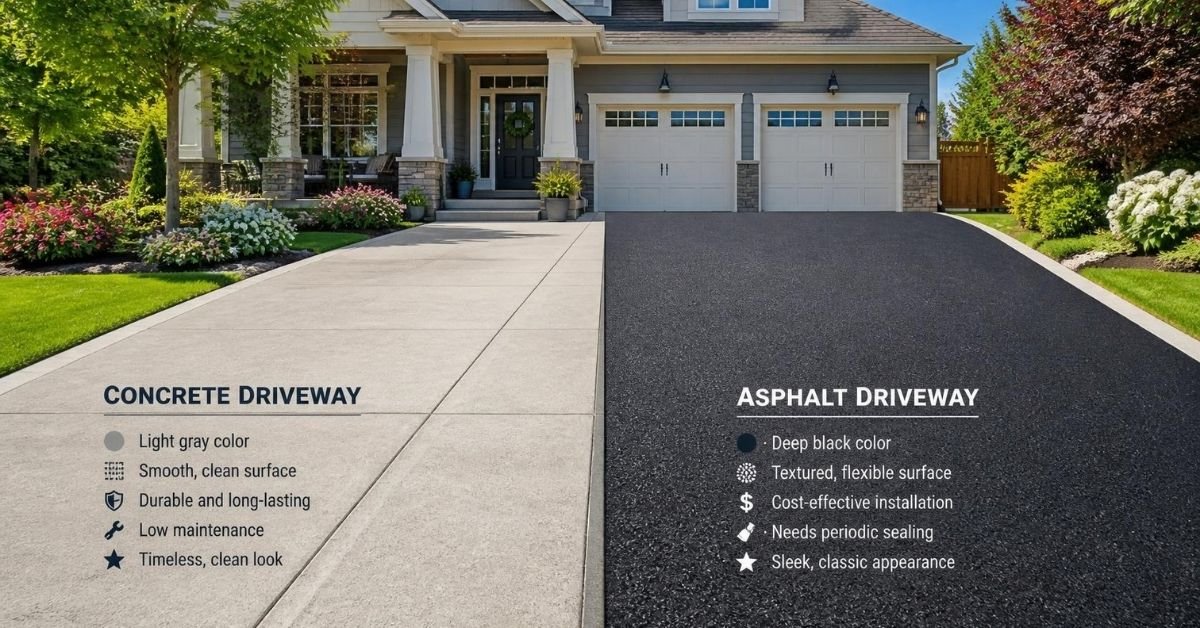
The real question behind “concrete vs. asphalt driveway” isn’t which material wins in general. It’s which one wins for your climate, your budget, your appearance expectations, and how long you plan to own the property. The honest answer flips depending on those four things.
One thing worth knowing before you read further: most published driveway comparisons come from parties with a material interest. Two of the main sources behind the figures in this article are state concrete associations that state a mission to increase concrete use, and a third is a concrete contractor that openly recommends concrete. The cost data comes from a U.S. consumer finance site, which draws on home-improvement pricing data and cites HomeAdvisor estimates. Pavement-life figures come from a state department of transportation but are cited by a concrete association. This article labels claims by who made them so you can weigh them, and it flags what the available information does not settle.
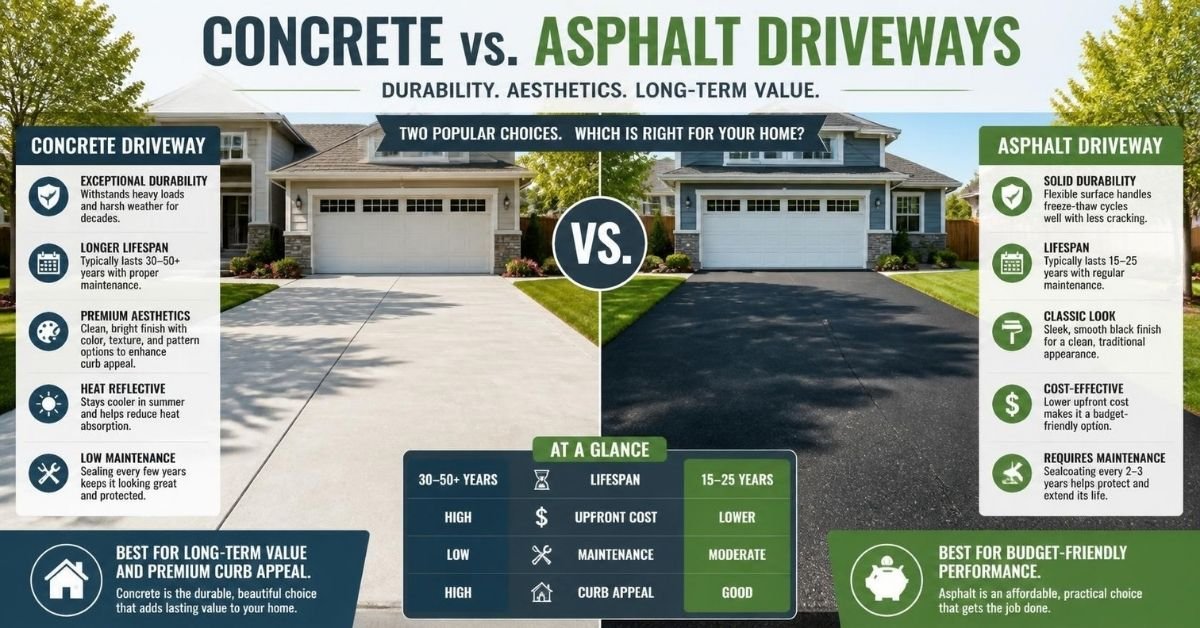
Here’s the fast orientation before the detail: asphalt generally costs less upfront and becomes usable sooner. Concrete generally lasts longer, offers far more design options, and takes longer to cure.
Concrete vs. Asphalt Driveway: The Short Answer
| Factor | Concrete | Asphalt |
|---|---|---|
| Reported average installed cost (U.S.) | Just under $6,500 | A little over $5,000 |
| Reported cost per square foot, including labor | $8–$20 | $7–$15 |
| Reported lifespan | 27.5-year average before repair; 30–40 years commonly cited | Typically 15–20 years; one table extends to 30 |
| Ready for vehicle traffic | Up to 7 days in one source; a 7-to-28-day cure window in another; light vehicles sometimes around 2 days in summer | About 1–3 days; resurfaced asphalt in a few hours |
| Reported maintenance cadence | Sealing every 3–5 years in two sources; about every 5 years depending on weather in another | Resealing every 2–4 years in one source; every 3–5 years in another; full recoating every 5–10 years in a third |
| Reported repair cost | $3–$25 per square foot | About $1–$3 per linear foot for minor cracks; $2–$5 per square foot for larger issues |
| Appearance | Stamped, stained, colored, exposed aggregate, polished, engraved | Mostly black or dark gray; can be painted; plain, dyed, or stamped finishes |
| Climate lean | Favored in hot climates | Favored in very cold climates |
Cost figures are U.S. averages in U.S. dollars, drawn from consumer home-improvement data current around 2025. They are averages, not quotes, and they don’t transfer to other countries or currencies.
The rest of this article expands each row — where the numbers come from, where sources disagree, and what actually decides durability — then closes with a decision framework rather than a verdict.
What Each Material Is and Why It Behaves Differently
Understanding the basic composition explains almost every later claim about cracking, load, repair, and climate performance. It also explains why the same event — a crack — means different things in the two materials.
Concrete: cement, water, and aggregates
Concrete combines aggregates such as sand and gravel with a paste of water and portland cement. It hardens into a rigid, solid structure. One concrete association describes it as resistant to sunlight and heavy loads, and notes that exterior mixes often contain air content — reported at 5 to 8 percent — specifically to withstand repeated freezing and thawing.
That rigidity is the key. Concrete distributes loads across a slab rather than flexing with the ground beneath it. It also means that when the ground moves more than the slab can tolerate, the slab relieves that stress by cracking.
Asphalt: bitumen and aggregates
Asphalt combines bitumen — a petroleum-based binder — with aggregates that may include sand, gravel, and recycled materials. It cures flexible rather than rigid. Sources describe that flexibility as an advantage in cold conditions, because the surface can move with freeze-thaw cycling instead of resisting it.
Flexibility cuts both ways. The same quality that helps asphalt tolerate ground movement makes it more prone to softening and deforming under sustained heat and heavy loads.
Both materials appear in the same broad range of applications: residential driveways, roads, parking lots, patios, and entryways. Keep that in mind later, when thickness and lifespan figures appear — some of the supporting data comes from parking lots and roadways rather than driveways specifically.
Upfront Cost: What Concrete and Asphalt Driveways Cost
Short answer: reported U.S. averages put asphalt lower upfront — a little over $5,000 on average for an asphalt driveway versus just under $6,500 for concrete.
Those averages, and everything in this section, are U.S. consumer home-improvement figures in U.S. dollars, current around 2025. They are national averages, not quotes, and actual prices vary by region, project size, finish, site access, and local labor market. Your local quotes are the only reliable project-level number.
Average installed cost and cost per square foot
Reported figures from that consumer cost data:
- Asphalt: a little over $5,000 on average, with a typical figure of $5,258 and a range of $3,128 to $7,391.
- Concrete: just under $6,500 on average, with a typical figure around $6,400 and a much wider range of $1,600 to $32,000.
- Per square foot, including labor: $7 to $15 for asphalt and $8 to $20 for concrete. The concrete per-square-foot range is attributed to Angi, a service that connects homeowners with home-improvement professionals.
The per-square-foot ranges come from the same consumer source, and the average installed figures are attributed there and elsewhere to HomeAdvisor estimates. Treat them as a starting point for a budget conversation, not as a prediction of your invoice.
What Changes the Price of Your Driveway
Two driveways of identical area can price very differently, because the headline averages bury the variables that actually drive cost.
Labor, finish, depth, gradient, and site access
- Labor. Reported at $2 to $10 per square foot for concrete and $5 to $7 per square foot for asphalt. For concrete, labor can account for as much as half the project cost — which is why a small change in site access can move the total more than a change in material.
- Finish. A plain concrete finish is the least expensive option; a high-end stamped finish costs significantly more. Plain asphalt costs less than dyed or stamped asphalt.
- Depth and build-up. Thicker sections and heavier base layers require more material and more excavation.
- Site preparation. Removing an existing driveway, grading, and excavation add cost. Asphalt projects that require excavation or grading take longer and cost more.
- Gradient and drainage. A sloped or poorly draining site requires more earthwork. One consumer source notes that pitch is an asphalt cost factor.
- Site access. Urban, remote, or difficult-to-access locations may carry higher labor costs.
- Added features and additives. Framing lumber, rebar, driveway aprons, and heated systems all add to a concrete project. Concrete mix composition also matters — the amount of cement, the type of concrete, and its strength all affect price.
- Permits. Any permit requirement is jurisdiction-specific. The available comparison research does not identify an applicable code, permit threshold, or right-of-way rule, so check with your local building or planning authority and confirm who is responsible for obtaining approvals.
Annualized cost over the life of the driveway
Annualized cost is where the two materials can flip rankings, but only when the assumptions are clear.
One concrete association cites a HomeAdvisor illustration for a 600-square-foot driveway: concrete at $93.86 per year over an expected 35-year life, versus asphalt at $125 per year over a 20-year life. Read that as an illustration, not a rule. The published source does not detail how the figure was calculated or which maintenance costs, if any, it includes.
More importantly, the source does not include an asphalt-industry or neutral perspective on long-term cost, and the research behind this article contains no quantified lifetime maintenance total for either material. So the direction of the comparison is plausible but not independently established. The practical takeaway is that upfront cost and total cost of ownership can point in different directions — which matters most if you plan to stay in the home long enough to capture the benefit of a longer-lived surface.
Lifespan and Durability: How Long Each Driveway Lasts
Lifespan is the section where sources disagree most, so here are the figures as reported rather than a single merged number.
| Lifespan claim | Concrete | Asphalt |
|---|---|---|
| Commonly cited range | 30 years or more; 30–40 years in one source | 15–20 years |
| Consumer cost data | 27.5 years on average before needing repair; 30–40 years with proper maintenance | 15–20 years in the article text; 15–30 years in that article’s own table |
| State DOT pavement figures, cited by a concrete association | 27.5 years for concrete pavement before repairs | 15.5 years for asphalt roadway |
| Specific design case | A Minnesota concrete pavement design expected to last more than 60 years with very little maintenance | — |
Concrete lifespan claims and why the range is wide
The 30-to-40-year figures and the 27.5-year average come largely from concrete-aligned sources. Two caveats apply. First, those are interested-party and consumer-source claims, not neutral findings. Second, the MDOT figures are roadway pavement numbers cited in a driveway context, and the Minnesota figure describes one specific pavement design — not a general expectation for a residential driveway. Treat the 60-year number as evidence that well-designed concrete pavement can last a very long time, not as a promise.
Asphalt lifespan claims and why the range is wide
The 15-to-20-year figure is widely repeated, but even within a single consumer article the text and the table disagree, with the table extending the range to 30 years. That inconsistency is worth noticing. It suggests the underlying data is a spread of outcomes rather than a fixed service life.
Both materials land anywhere in their ranges because of the same variables: installation quality, slab or pavement thickness, base and subgrade condition, drainage, jointing for concrete, sealing history, de-icing salt exposure, traffic load, and local climate. A driveway at the unlucky end of its range usually got there through one of those factors, not through the material choice alone.
Maintenance: Sealing, Repair, and Replacement Over the Years
Maintenance is the least glamorous factor and often the decisive one — because the cadence you keep directly affects how long the driveway lasts.
| Item | Concrete | Asphalt |
|---|---|---|
| Reported sealing cadence | Every 3–5 years (two sources); about every 5 years depending on weather (another) | Every 2–4 years (one source); every 3–5 years (another); full recoating every 5–10 years (a third) |
| What sealing protects against | Moisture, road salt, and de-icing chemicals | Water damage, UV exposure, oil spills, and general surface breakdown |
| Reported repair cost | $3–$25 per square foot | About $1–$3 per linear foot for minor cracks; $2–$5 per square foot for larger issues such as minor sinking, crumbling, or potholes |
| Repair character | Less frequent, more expensive per repair | Quicker and cheaper per repair, but more frequent |
| Overlay as an alternative | $3–$7 per square foot over existing asphalt or concrete | Same |
Sealing a concrete driveway
Sources disagree on the interval — two put it at every three to five years, while another describes cleaning and sealing in sections roughly every five years depending on weather. All three sources have a concrete interest. The practical move is to treat the interval as a starting point and confirm locally, because weathering varies enormously by region.
Proper sealing matters more than the exact cadence suggests. One contractor source notes that sealing helps concrete resist damage from road salt and de-icing chemicals, and another describes sealed concrete as retaining its color better over time. The research does not quantify how much sealing extends service life.
Resealing and recoating an asphalt driveway
The reported intervals conflict more sharply here: every two to four years in one source, every three to five years in another, and full recoating every five to ten years in a third. What the sources agree on is the consequence of skipping it. Neglecting sealing or resealing accelerates deterioration, leaves the surface more exposed to salt and moisture, and invites cracking.
One practical detail from a concrete-source article: asphalt’s dark surface causes snow and ice to melt faster than on a lighter surface. That’s a genuine winter convenience, separate from any durability question.
Crack and pothole repair costs
Repair economics differ in structure, not just in price. Asphalt repairs are described as quicker and cheaper but needed more often; concrete repairs are described as less frequent but more costly when they come.
Concrete repair runs $3 to $25 per square foot in the reported data. For asphalt, minor crack repair runs about $1 to $3 per linear foot, while larger issues — minor sinking, crumbling, or potholes — run $2 to $5 per square foot. These are U.S. consumer figures in U.S. dollars current around 2025 and vary by region and severity.
Two habits pay off regardless of material. First, inspect the surface regularly so you catch minor damage before it spreads. On concrete, repairing minor surface cracks early helps prevent further damage. On asphalt, cracks and potholes typically lead to patching or resurfacing.
The research contains no quantified long-term maintenance cost totals over a full lifespan for either material, so any article that hands you a single “lifetime maintenance cost” figure is going beyond what the data supports.
How Climate Affects Your Choice
Climate is one of the few factors that can decide the question outright — but the cold-climate claims come largely from concrete-aligned sources, and they contradict each other, so read carefully.
Cold climates, freeze-thaw cycles, and de-icing salt
The sources split here:
- Consumer cost data and one concrete association say asphalt is the better bet in very cold climates, on the grounds that concrete can crack in extreme cold while asphalt’s flexibility helps it tolerate freeze-thaw movement.
- One concrete contractor and one concrete association say the opposite — that concrete handles freeze-thaw better, provided the mix is air-entrained, the slab is properly jointed, and the surface is sealed. That association reports exterior concrete mixes often contain 5 to 8 percent air content for exactly this reason.
Both positions can be true at once. Properly specified and installed concrete can perform well in freeze-thaw conditions; concrete that lacks air entrainment, jointing, or drainage may not. Since the more optimistic claims come from parties selling concrete, ask any contractor recommending concrete in a cold climate to explain their mix, jointing, and drainage approach specifically.
De-icing salt and road salt are a genuine degradation concern for both materials. Proper sealing helps concrete resist them, and skipping sealing on asphalt leaves it more exposed to moisture and salt damage. Michigan and Minnesota are cited in the research as states with the extreme temperature swings that stress pavements hardest.
Hot climates, heat absorption, and surface temperature
Hot climates favor concrete in the reported sources. Asphalt is described as softening in consistently high temperatures and at risk of rutting, deformation, and cracking, and as absorbing heat.
One concrete association claims concrete can stay as much as 10 degrees cooler than asphalt and that asphalt’s heat absorption can raise temperatures inside parked cars. That specific temperature claim is an interested party’s assertion without cited testing, so treat it as directionally plausible rather than verified.
Surface color also affects winter behavior. Asphalt’s dark surface is described as causing snow and ice to melt faster, while concrete’s lighter surface retains color better when sealed. Asphalt, meanwhile, is described as fading from black toward a dull gray over time.
One factor applies in every climate: drainage. Both materials require effective drainage, and an uneven or poorly drained base causes potholes and excessive cracking regardless of what you pour on top. Note that the available research does not cover driveway slope, drainage design, soil type, or frost depth as design inputs — those are project-specific factors to confirm with a local contractor or engineer.
Installation Timeline: Curing, Drying, and When You Can Drive On It
Curing and drying are different processes, and the gap between them is one of the more practical differences between the two materials.
Asphalt is reported as dry enough for foot and vehicle traffic in about 48 to 72 hours, with one consumer source describing roughly one to three days. Resurfaced asphalt can be ready in a few hours. Concrete is reported as requiring up to seven days before traffic in one source, with a 7-to-28-day cure window in another. In summer, one association states that light passenger vehicles can usually drive on new concrete pavement after about two days.
How long before the driveway can take traffic
Two caveats matter more than the specific numbers. First, concrete curing time depends on weather, so a cold or damp week changes the schedule. Second, these are reported figures rather than guarantees — ask your contractor for a timeline specific to your project and season.
Plan around the window before work starts:
- Where will vehicles park during the cure or dry period?
- How will deliveries, service visits, and accessibility needs be handled?
- How will people and pets be kept off the surface?
- What is the contractor’s access plan if the driveway is the only route to the property?
Keep people and pets off freshly placed and curing surfaces throughout the restriction period, and confirm the exact timeline with your contractor rather than assuming a fixed number of days.
Base Preparation and Thickness: Why Installation Quality Decides Durability
If there’s one section that determines whether your driveway cracks, settles, or develops potholes, it’s this one — and it applies to both materials almost equally.
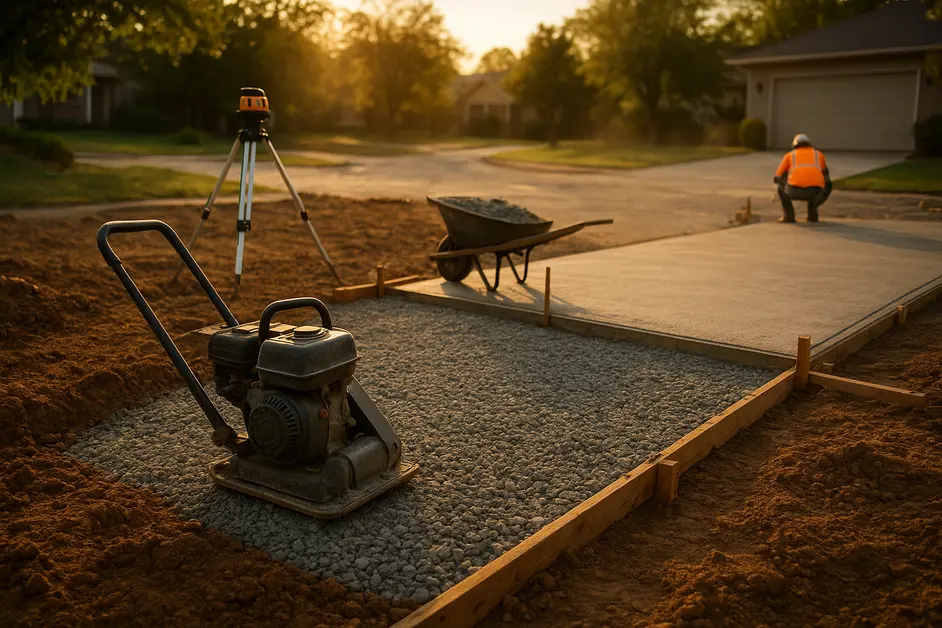
Subgrade, subbase, and the base preparation checklist
The base preparation steps reported for both materials:
- Remove all sod, topsoil, and vegetation.
- Check the subgrade for wetness.
- Ensure the subgrade soils are uniform, without abrupt transitions from hard to soft.
- Place a leveling course of sand or gravel.
- Finish the grade so the surface material ends up at uniform thickness.
A good subgrade is described as reasonably even, uniform in its upper portion, and free of frost-susceptible soils or isolated hard and soft spots. Drainage and base quality appear repeatedly in the research as the factors that decide whether either material cracks or develops potholes — a poorly drained base will undermine a concrete driveway and an asphalt driveway alike.
Placement differs. Concrete is described as spread in a single full layer of roughly 4 to 8 inches. Asphalt is typically placed in at least two applications of 1.5-to-2-inch layers, because the first application alone isn’t described as strong enough to carry traffic for the long term.
One concrete-aligned source claims asphalt surfaces usually need a deeper gravel bed — 6 to 8 inches in a parking lot example — while a properly prepared subgrade may reduce concrete’s subbase needs to a light layer of sand or gravel. That’s an interested party’s claim and should be verified with local contractors who install both materials.
Thickness guidance by traffic load
The general ranges below come from a single concrete-association source. They are not specifications. Correct build-up depends on your subgrade soil and the aggregate base thickness and type, and it must be set locally by a qualified contractor or engineer.
| Traffic use | Concrete (general range) | Asphalt (general range) |
|---|---|---|
| Light residential use, passenger vehicles | About 4 inches | About 6–8 inches granular base with 2–3 inches asphalt |
| Medium use, light-to-medium trucks and some heavy trucks | About 5 inches | About 8 inches granular base with 4 inches asphalt |
| Heavy commercial and industrial truck use | About 6 inches | About 6 inches hot mix asphalt over an 8-inch aggregate base |
Two limitations are worth stating plainly. Much of the load and thickness detail in the research comes from parking lot and roadway examples rather than driveways, so heavy-vehicle durability data specific to residential driveways is thin. And the research contains no mix design, joint spacing, reinforcement, compaction, or drainage design specifications. Do not treat these ranges as a design — have a qualified local contractor or engineer confirm the build-up for your site.
Appearance and Customization Options
If appearance is your deciding factor, this is the clearest split in the comparison: concrete offers substantially more options, and asphalt’s palette is narrow.
Stamped, stained, and exposed-aggregate finishes
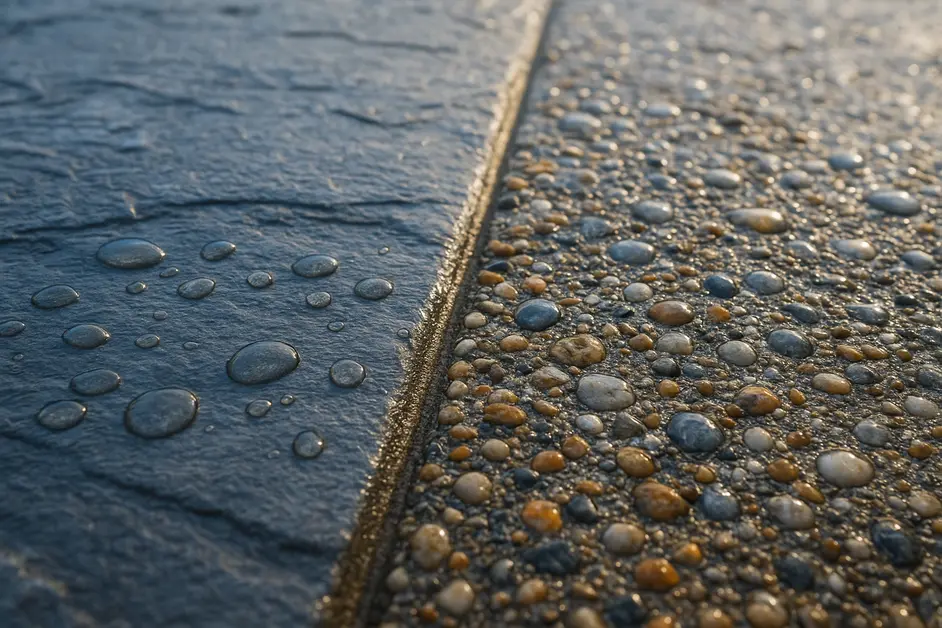
Reported concrete finishes include stamped, stained, colored, exposed aggregate, polished, and engraved. Stamping can replicate the look of natural stone, pavers, slate, or flagstone. Sealed concrete is also described as retaining its color better than asphalt over time.
These finishes feed directly back into cost. A plain concrete finish is the most affordable option, while a high-end stamped finish costs significantly more. The available research does not quantify the premium for decorative finishes, so ask contractors for line-item pricing rather than estimating an add-on.
Why asphalt’s appearance options are more limited
Asphalt is typically black or dark gray and is described as fading toward dull gray as it ages. It can be painted, and it does come in plain, dyed, and stamped finishes — but the range is far narrower than concrete’s, and the sources describe asphalt’s appearance as not very customizable overall.
Related reading worth searching for on our site: a comparison of decorative concrete finishes by look, upkeep, and relative cost, which the available research flags as an area where more detail is needed.
Repair Costs and When Resurfacing Makes Sense
An overlay is cheaper than replacement — reported at $3 to $7 per square foot over existing asphalt or concrete — but it only makes sense under the right conditions.
The first question is whether the problem is in the surface or in the base. Base failures are described in the research as a leading cause of potholes and excessive cracking. If your driveway is cracking in a pattern, sinking, or forming potholes repeatedly, the base or drainage is the likely culprit, and an overlay placed over a failing base will inherit the same problem. An uneven, poorly drained base produces potholes and excessive cracks no matter what material sits on top.
Overlay versus full replacement
Work through these in order:
- Age. How far into the reported lifespan range is the driveway? An overlay on a surface near the end of its expected life buys less time.
- Extent and pattern of damage. Isolated cracks and a few potholes suggest a surface problem. Widespread, repeating cracking suggests something underneath.
- Base and drainage condition. If the base is failing or water isn’t draining, an overlay addresses the symptom rather than the cause.
- Cost comparison. Compare the overlay figure against repair and replacement options in your local quotes.
- Repair history. Frequent repairs on the same area are a signal that replacement may be the better value.
Note that the research does not provide expected repair timelines by age or percentage-of-cost thresholds for deciding between overlay and replacement. Those thresholds are decisions to make with a local contractor who has seen your driveway.
Also worth knowing: on asphalt specifically, one contractor source describes resurfacing as a temporary appearance fix rather than a permanent solution.
Other Driveway Options Worth Pricing
If your real priority is lowest upfront cost, least maintenance, or best drainage, concrete and asphalt may not be the right frame at all.
| Option | Reported installed cost (U.S.) |
|---|---|
| Paver driveways | $6,000–$18,000 |
| Gravel driveways | $1,800–$3,500 |
| DIY gravel driveway | About $700–$1,000 in materials plus about $150 in tools |
Paver per-square-foot ranges reported by type: stone pavers $15–$60, permeable pavers $10–$70, concrete pavers $10–$25, cobblestone pavers $18–$50, and brick pavers $10–$45.
Paver and gravel driveway costs
Permeable pavers are the alternative most associated with managing runoff in the available research, which makes them worth pricing if drainage is your main concern. Gravel is the cheapest option and the only one of the group where a do-it-yourself installation is realistically described — though the same source that gives the DIY gravel numbers recommends professional installation for asphalt and concrete.
Compare these against concrete and asphalt on the same axes: upfront cost, expected lifespan, maintenance cadence, appearance, and whether you can install it yourself. Gravel wins clearly on upfront cost. Pavers sit in a broad middle band where the specification drives the price more than the material name.
How to Choose: A Decision Framework
Rather than a verdict, here’s a structured way to reach your own answer. Work through the axes in order — the first one you answer determines which of the rest actually matter.
- Set your priority order first. Is it lowest upfront cost, longest trouble-free service, best appearance, or fastest usable driveway? The answer changes the recommendation, and no comparison can rank the materials until you’ve ranked your own criteria.
- Climate. In a cold-winter region, weigh the freeze-thaw split carefully — the sources genuinely disagree, and both positions come with conditions. In a hot region, the reported lean is toward concrete.
- Budget horizon. Compare your upfront budget against total cost of ownership over the period you expect to keep the property.
- Cosmetic priority. If a plain functional surface is fine, appearance drops out of the decision. If you want stamped or decorative finishes, concrete is the only one of the two offering that range.
- Length of ownership. A shorter ownership horizon changes the math, because you capture less of a long-life material’s value. This cuts both ways: you also inherit less of its maintenance burden.
- Maintenance appetite. Are you willing to reseal every few years, or would you rather pay more upfront for less frequent intervention?
- Load. Passenger vehicles only, or light trucks and heavier equipment? Load drives thickness and build-up requirements more than it drives material choice.
- Drainage and base conditions. Whatever you choose, the base does the deciding. Get this assessed before comparing materials.
What remains uncertain after all that: the cost data is national rather than regional, the durability and climate claims lean heavily on interested parties, and the design specifications your project actually needs can only come from local professionals. That’s not a gap in your research — it’s the point at which you talk to contractors.
Hiring a Contractor and What to Verify
Both materials need professional installation. The available research describes do-it-yourself installation as impractical without contractor-level experience: the work requires specialized tools such as a jackhammer, intense physical labor, and specific skills, and doing it wrong can mean costly repairs or a short driveway life.
This is safety-critical, equipment-heavy work. It involves excavation, heavy machinery, and freshly placed materials, and mistakes can be expensive in both money and safety. If you are not an experienced professional contractor, hire one. During the cure or dry period, keep people and pets off the surface.
Questions to ask before you sign
- How many driveways like mine have you installed in this climate and with this material?
- How do you prepare the subgrade and base, and how do you handle drainage on my site?
- What thickness and build-up are you proposing, and why?
- What is the access plan while the driveway cures or dries?
- What warranty do you offer, and what does it cover?
- Do I need a permit, and who is responsible for obtaining it?
- What is the recommended sealing or resealing schedule for my situation?
Also get several local quotes and ask each contractor to justify their recommendation. Given how much available driveway comparison content comes from one side of the market, a single-material pitch without reasoning is a reason to keep shopping. Contractors who install both materials are the most useful comparison point.
Contractor certification and verification
For concrete work, one association identifies the American Concrete Institute (ACI) Flatwork Finisher certification as relevant for concrete contractors, with the association describing certified contractors as meeting requirements for durable concrete, knowing how to cure in specific conditions, and knowing the appropriate mix for the work.
Verify locally: contractor licensing and insurance requirements vary by jurisdiction. The research behind this article does not identify any applicable code, permit threshold, or right-of-way rule, so check with your local building or planning authority rather than relying on general guidance. The same applies to whether a covered permit or a right-of-way approval is needed.
Where These Numbers Come From — and What They Don’t Tell You
This section exists because the source base for driveway comparisons is unbalanced, and knowing that changes how you read everything above.
| Source type | What it contributes | How to weigh it |
|---|---|---|
| Two state concrete associations, each stating a mission to increase concrete use | Lifespan figures, maintenance cadence, thickness guidance, load-equivalence and surface-temperature claims, base preparation checklist | Interested parties. Useful for technical process detail and for understanding what concrete advocates emphasize; lifespan and cost claims should be read as advocacy until independently confirmed |
| A concrete contractor that openly recommends concrete | Cold-climate field observations, sealing intervals, appearance comparisons | Interested party with direct project experience. Valuable for practical detail, not neutral on material choice |
| A U.S. consumer finance site carrying home-improvement cost data | Average installed costs, per-square-foot ranges, lifespan ranges, repair costs, alternative material costs | Consumer-oriented cost data, with per-square-foot ranges attributed in turn to Angi and installed-cost figures to HomeAdvisor estimates. Independent of the concrete industry, but still an average rather than a quote |
| State DOT pavement-life figures, cited by a concrete association | 27.5-year concrete pavement and 15.5-year asphalt roadway averages | Originally neutral data, but roadway figures cited in a driveway context by an interested party |
What the available research does not establish
- No asphalt-industry or neutral technical perspective on durability and lifespan.
- No regional or city-level cost breakdown.
- No building code, permit threshold, zoning, or right-of-way guidance.
- No mix design, joint spacing, reinforcement, compaction, or drainage design specifications.
- No quantified long-term maintenance cost total across a full lifespan.
- No environmental or sustainability comparison beyond the note that asphalt aggregates may include recycled materials.
- No snow and ice removal guidance, including plowing damage or de-icing product selection.
- No warranty terms or expected repair timelines by age.
- No resale value or return-on-investment analysis. The one curb-appeal claim in the sources is unquantified and unsupported, so don’t treat a decorative driveway as a measurable return.
- Limited heavy-vehicle durability detail in a driveway context, since most load and thickness data comes from parking lots and roadways.
- No driveway slope, soil type, or frost depth design inputs.
Three claims appear in the sources but are unverified interested-party assertions: that 5-inch concrete carries the same load as 8-inch asphalt, that concrete stays as much as 10 degrees cooler than asphalt, and that concrete takes half the construction time of asphalt. Treat all three as sales talking points rather than findings.
How to spot a biased driveway comparison while you research
- Check who published it. An association or contractor with a material interest isn’t automatically wrong, but its lifespan and cost claims deserve a second source.
- Watch for single figures where a range is honest. A comparison that states one asphalt lifespan without acknowledging that sources disagree is smoothing over uncertainty.
- Be suspicious of precise claims with no citation — load equivalence, temperature differences, and time savings in particular.
- Look for the base preparation and drainage discussion. Any comparison that skips it isn’t comparing what actually determines how long a driveway lasts.
Frequently Asked Questions
How long does a concrete driveway last compared to an asphalt driveway?
Reported figures put concrete at 30 years or more, 30 to 40 years in one source, with a 27.5-year average before needing repair in consumer cost data. Asphalt is typically reported at 15 to 20 years, though one article’s own table extends that to 30. The sources disagree, and the real outcome depends on thickness, base and subgrade, drainage, jointing, sealing, salt exposure, load, and climate.
Which is cheaper upfront, concrete or asphalt?
Reported U.S. averages put asphalt lower: a little over $5,000 installed on average versus just under $6,500 for concrete. These are U.S. averages in U.S. dollars from consumer home-improvement data current around 2025. Actual prices vary by region, size, finish, site access, and labor market, and local quotes are the only project-level number.
How much does a concrete driveway cost per square foot compared with asphalt?
Reported figures are $8 to $20 per square foot for concrete and $7 to $15 for asphalt, both including labor. The concrete range is attributed in the consumer source to Angi. These are U.S. averages current around 2025 and shift with finish, thickness, site prep, and location.
How often does an asphalt driveway need sealing?
The sources disagree: every two to four years in one, every three to five years in another, and full recoating every five to ten years in a third. Skipping resealing accelerates deterioration and exposure to salt and moisture. Confirm the right interval for your climate locally.
How often does a concrete driveway need sealing?
Every three to five years in two sources, and about every five years depending on weather in another. The sources disagree, and all of them have a concrete interest, so treat the interval as a starting point and confirm locally.
Which driveway material handles cold weather and freeze-thaw cycles better?
The sources split. Consumer cost data and one concrete association favor asphalt in very cold climates because concrete can crack in extreme cold, while a concrete contractor and another concrete association argue concrete handles freeze-thaw better when the mix is air-entrained, the slab is properly jointed, and the surface is sealed. Both positions have conditions attached, so ask any contractor recommending one material in a cold climate to explain their mix, jointing, and drainage approach.
Which driveway material is better in a hot climate?
The reported lean is toward concrete, because asphalt is described as softening in sustained heat and at risk of rutting and deformation. One concrete association also claims concrete stays as much as 10 degrees cooler — that figure is an interested party’s assertion without cited testing and should be treated as unverified.
How long before I can drive on a new concrete or asphalt driveway?
Asphalt is reported as ready for foot and vehicle traffic in about 48 to 72 hours, with one consumer source saying roughly one to three days, and resurfaced asphalt ready in a few hours. Concrete is reported at up to seven days in one source, with a 7-to-28-day cure window in another and light passenger vehicles sometimes permitted after about two days in summer. Concrete curing time depends on weather.
What does it cost to repair cracks or potholes in each material?
Concrete repair runs $3 to $25 per square foot. Asphalt minor crack repair runs about $1 to $3 per linear foot, and larger asphalt issues such as minor sinking, crumbling, or potholes run $2 to $5 per square foot. These are U.S. figures in U.S. dollars current around 2025 and vary with severity and location.
Is an overlay cheaper than replacing a driveway?
Yes — an overlay is reported at $3 to $7 per square foot over existing asphalt or concrete, well below typical replacement costs. But suitability depends on whether the damage is in the surface or the base, how much of the driveway’s expected life has passed, and the extent and pattern of damage. Overlaying a failing base doesn’t fix the base.
Can a concrete driveway be customized to look like stone or pavers?
Yes. Reported finishes include stamped, stained, colored, exposed aggregate, polished, and engraved, and stamping can replicate natural stone, pavers, slate, or flagstone. The available research does not quantify the cost premium for decorative finishes, so get line-item pricing from contractors.
Can I install a concrete or asphalt driveway myself?
No, not unless you are an experienced professional contractor. The work requires specialized tools such as a jackhammer, intense physical labor, and specific skills, and errors can mean costly repairs or a short driveway life. It also involves excavation and heavy equipment, and freshly placed surfaces must be kept clear of people and pets during curing or drying.
Should I trust a driveway recommendation from a concrete company or association?
Read it as an informed but interested perspective. Two of the main comparison sources are state concrete associations with stated missions to increase concrete use, and another is a concrete contractor that recommends concrete. That doesn’t make them wrong about process detail, but their lifespan, cost, and performance claims deserve independent confirmation. Ask for reasoning and get quotes from contractors who install both materials.
Do I need a permit to build or replace a driveway?
The available research does not identify any applicable code, permit threshold, or right-of-way rule, so there’s no reliable general answer. Check with your local building or planning authority, and confirm with your contractor who is responsible for obtaining any required approval.
Are paver or gravel driveways worth considering instead?
They can be, depending on your priority. Paver driveways are reported at $6,000 to $18,000 installed, with permeable pavers — the option most associated with managing runoff — running $10 to $70 per square foot. Gravel is reported at $1,800 to $3,500, with a DIY materials example of about $700 to $1,000 plus about $150 in tools. Gravel is the clear winner on upfront cost; pavers offer the widest range of appearance and drainage options.
The Bottom Line
There is no universal winner in the concrete vs. asphalt driveway comparison. Asphalt generally costs less upfront and is ready for traffic sooner. Concrete generally lasts longer, tolerates heat better, and offers far more design options — at a higher upfront cost and a longer cure window. Which of those trade-offs you prefer depends on your climate, your budget horizon, how much appearance matters to you, and how long you plan to own the property.
Two things are worth doing before you commit. First, get several local quotes from contractors who install both materials, and ask each to justify their recommendation — the sources behind most driveway comparisons have a material interest, and a single-material pitch without reasoning tells you something. Second, treat the base and drainage as the decision that outranks the surface choice, because that’s what determines whether either driveway cracks, settles, or develops potholes years from now.
And keep in mind what the available data doesn’t resolve: there’s no neutral technical perspective on lifespan, no regional cost breakdown, and no design specification that applies to your site without local input. Use the figures here to frame better questions, then let a qualified local contractor or engineer answer those questions for your driveway.